
WordPress vs Shopify for Oxfordshire Ecommerce Businesses: An Honest Comparison
The WordPress vs Shopify decision for Oxfordshire ecommerce businesses comes down to three priorities: how much control you want over your store, how much time you want to spend managing it, and what your product catalogue looks like. Shopify is the simpler, more managed solution, hosting, security, and platform updates are handled automatically. WooCommerce on WordPress gives you complete ownership, more flexibility for complex requirements, and lower ongoing costs, but requires more active technical management. Most Oxfordshire small ecommerce businesses with straightforward product catalogues and a preference for simplicity are better served by Shopify. Businesses with complex products, B2B pricing, or existing WordPress infrastructure typically benefit more from WooCommerce.
Every Oxfordshire business considering selling online faces the same choice: WordPress with WooCommerce, or Shopify? It is one of the most significant decisions you will make about your ecommerce operation, because once your store is built on a platform and your products are uploaded, customers are buying, and your marketing is driving traffic to it, switching platforms is expensive and disruptive.
We build both WooCommerce and Shopify stores for Banbury and Oxfordshire businesses, and we do not have a vested interest in recommending one over the other, both produce revenue for us. What we do care about is recommending the right platform for your specific situation. This article gives you the honest comparison to make that decision.
The Fundamental Difference: Hosted vs Self-Hosted
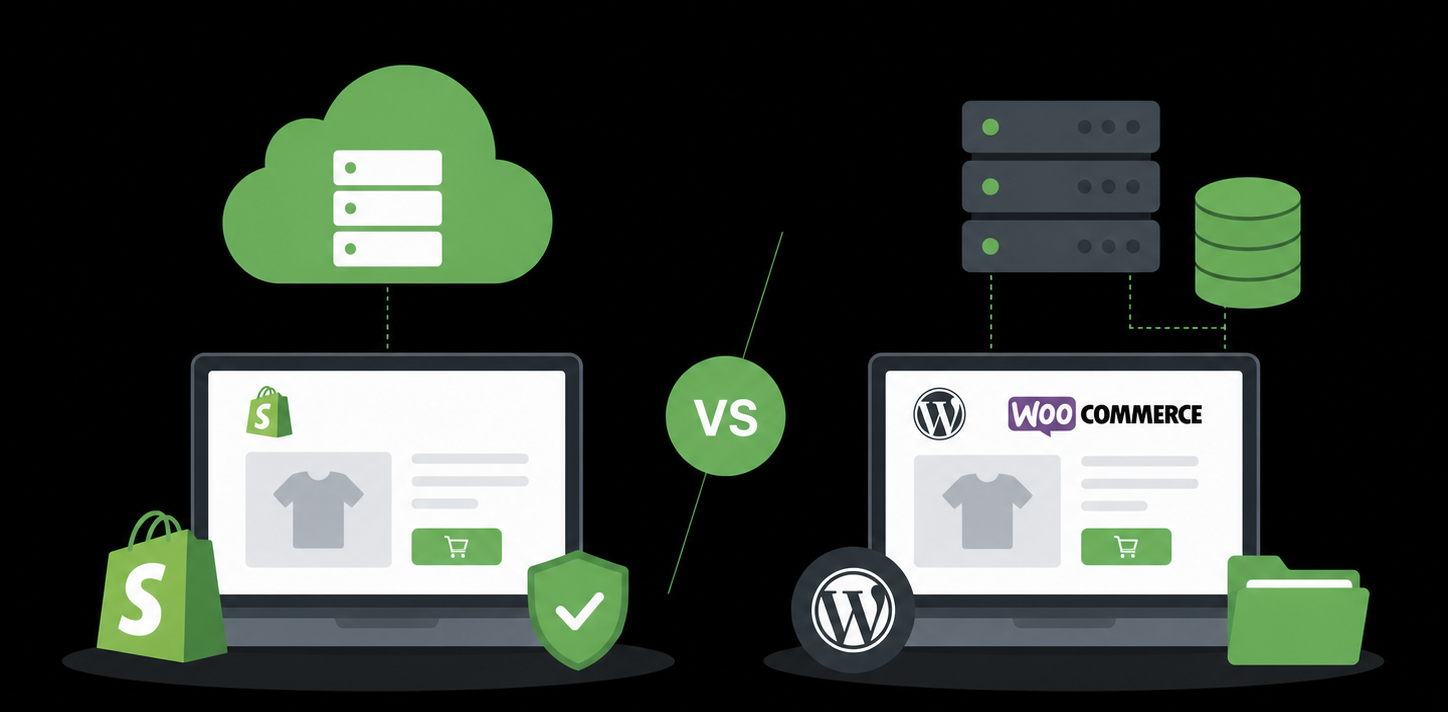
Shopify is a hosted platform. Your store lives on Shopify’s servers, running on Shopify’s software, subject to Shopify’s terms and pricing. Shopify handles hosting, security patches, platform updates, and PCI compliance (the security standard for processing card payments) automatically. You are, in the most fundamental sense, a tenant, your data lives on Shopify’s infrastructure and your business depends on Shopify’s ongoing operation and policy decisions.
WordPress with WooCommerce is self-hosted. The WordPress software and WooCommerce plugin are installed on your own hosting account (or a hosting account we manage for you). You own the software, you own the data, you own the files. You can move your store to any host at any time, export all your customer and order data, and continue operating regardless of what happens to the companies that made the software (WordPress and WooCommerce are both open-source and cannot be “shut down”).
For most small Oxfordshire ecommerce businesses, the practical implications of this distinction are more important than the philosophical ones. Let’s look at what each model means day-to-day.
Total Cost of Ownership: 3-Year Comparison
The upfront cost and ongoing cost profiles of the two platforms are significantly different, and the right comparison is total cost of ownership over a meaningful period rather than headline monthly pricing.
Basic Shopify at £29/month, Shopify at £65/month. Over 3 years: £1,044 to £2,340.
2% per transaction on Basic (waived if using Shopify Payments).
Average Oxfordshire Shopify store uses £50-£150/month in apps. Over 3 years: £1,800 to £5,400.
Custom Shopify theme build typically £2,500-£4,500.
Typically £6,000 to £12,000 including build and running costs for a small store.
Managed WordPress hosting at £20-£50/month. Over 3 years: £720 to £1,800.
No transaction fees on WooCommerce itself (payment gateway fees apply to both platforms similarly).
Most required WooCommerce functionality uses free plugins or one-time licence fees (£50-£200) rather than monthly subscriptions.
If managed maintenance is included (as it is in our hosting service), £0 additional. If billed separately, £50-£100/month.
Custom WooCommerce build typically £3,000-£5,000 (higher than Shopify due to complexity).
Typically £5,000 to £10,000 including build and running costs for a small store.

Our Recommendation for Oxfordshire Businesses
Choose Shopify if: you want simplicity above everything else, you have a straightforward product catalogue, you do not have existing WordPress infrastructure, and you want to minimise the technical management overhead of running your store.
Choose WooCommerce if: you want full ownership of your data and code, you have complex product or pricing requirements (particularly B2B), you already have a WordPress website you want to add ecommerce to, or you want the maximum flexibility for future development without platform constraints.
If you are genuinely uncertain, book a free initial consultation. We will ask the right questions about your products, customers, and technical requirements, and give you an honest recommendation for your ecommerce web design Banbury project rather than defaulting to whichever platform is easier for us to build on.
Day-to-Day Management: Who is Doing the Technical Work?
With Shopify
Shopify’s day-to-day management is straightforward for non-technical business owners. Adding products, updating prices, processing orders, managing inventory, setting up discount codes, and viewing sales reports are all simple tasks within the Shopify admin. Platform updates happen automatically without your involvement. Security is managed by Shopify. If something goes wrong with the platform itself, Shopify’s support team handles it. The trade-off is that you are dependent on Shopify’s infrastructure and decisions. Shopify has changed its pricing, transaction fee structure, and feature set multiple times, and as a Shopify merchant your options are to accept the changes or migrate your store elsewhere. Our Shopify web design Banbury service handles the full build and setup for you.
With WooCommerce
WooCommerce requires more active management. WordPress core, WooCommerce core, plugins, and themes all need regular updates, and updates need testing before application to the live store to prevent conflicts that break functionality. Database maintenance, security monitoring, and backup management are the store owner’s responsibility (or their hosting provider’s, if managed hosting is used). This additional overhead is the primary reason many smaller Oxfordshire ecommerce businesses prefer Shopify. However, for businesses using a managed hosting and maintenance service, like the service we provide for WooCommerce clients, the day-to-day management overhead is largely eliminated. Updates are handled on staging, tested, and pushed to the live store; backups are automated; security is monitored. The flexibility of WooCommerce without the management burden — our WooCommerce developers Banbury team can set this up for you.
Don’t Worry, You are in Good Hands!

We’ve used Banbury Website Design for several projects now and the quality is consistently excellent. Fast turnaround, clean output, and they actually listen to what you need rather than delivering something generic. Already booked in for the next one.

Very happy with the work and will definitely be using them again. Two projects in now and both were delivered on time without any fuss. The communication throughout made the whole process straightforward.
Would highly recommend. The team goes above and beyond to make sure the final product actually meets what you had in mind, not just what was written in the brief. You can tell they genuinely care about the quality of what they deliver.
Working with Banbury Website Design is always a great experience. The work gets done fast, communication is consistent, and the end result is exactly what we needed. We’ve worked with them on multiple projects and that standard hasn’t dropped.
The website they built is really unique and well put together. It gave our business a completely new look, something we’d been putting off for a long time. We’ve already had people comment on how much more professional the site feels. Would absolutely recommend.
They put real effort into understanding our business before touching the design. The result was a fully functional, creative website that genuinely reflects what we do. Delivered on time, always available for adjustments, and very professional throughout.
Pays close attention to detail and the work reflects it. We had a fairly complex project and it was handled professionally from start to finish. We’ll keep working with them.
Platform Ranks Better on Google
Product and Functionality Flexibility
Where Shopify Excels
Shopify handles the vast majority of ecommerce use cases well. Simple and variable products, digital downloads, subscription billing, multi-currency, gift cards, discount structures, and basic B2B account management are all well-served by either native Shopify functionality or Shopify apps. For most Oxfordshire retailers with standard product catalogues and conventional customer relationships, Shopify’s out-of-the-box capability is sufficient.
Shopify’s app ecosystem (over 8,000 apps) extends its capability significantly, but apps add monthly costs, typical Shopify stores use 5 to 15 apps at £5 to £30 per app per month. This app layer can meaningfully increase the effective cost of a Shopify store compared to headline platform pricing.
Where WooCommerce Excels
WooCommerce genuinely outperforms Shopify for complex requirements. B2B pricing, where different customer groups pay different prices for the same products (retail, trade, wholesale, distributor), is far more naturally handled by WooCommerce than Shopify. Complex product configurations, build-your-own product customisers, dependent product variations, conditional pricing, are more naturally addressed through WooCommerce’s open architecture than Shopify’s app ecosystem.
For Banbury manufacturers and trade suppliers considering ecommerce, WooCommerce’s B2B capability is often the deciding factor. Trade account management, minimum order quantities, volume-based pricing tiers, and integration with existing ERP or stock management systems are all areas where WooCommerce consistently outperforms Shopify for the Oxfordshire manufacturing and distribution market.
SEO Comparison: Which Platform Ranks Better on Google?
Both Shopify and WooCommerce are capable of ranking well on Google when properly optimised. Both support meta titles and descriptions, XML sitemaps, structured data, clean URL structures, and image optimisation. Neither has an inherent SEO advantage from a technical standpoint.
Where the platforms differ is in the ease of advanced SEO implementation. WooCommerce on WordPress with RankMath Pro gives fine-grained control over every SEO element, individual schema types for every product, granular canonical URL control, advanced breadcrumb configuration, and the ability to implement custom schema beyond what standard plugins offer. Shopify’s SEO controls are good but less granular, and some SEO configurations that are straightforward in WordPress require app purchases or custom Liquid code in Shopify.
For Oxfordshire ecommerce businesses where SEO is a primary customer acquisition channel, rather than paid social or offline marketing, WooCommerce’s SEO flexibility gives it an edge over Shopify for advanced implementations. Our WordPress SEO Banbury service can help you make the most of that flexibility.
Frequently Asked Questions
Start Your Journey with Banbury Website Design Company!

Bolton Road, Banbury OX16 5UL, UK